Platform

Inside the Ibis Operating System

Ibis brings evolving knowledge and human action together to keep care continuous. HealthGraph is the knowledge system; Scio, the inference engine embedded within it, continuously creates new knowledge through inference and feedback across concepts and time.

The architecture begins with the member. HealthGraph includes each member’s Digital Twin for Health; Scio develops new knowledge within HealthGraph; and IbisHub and IbisNexus connect members and Care Circles to that knowledge so they can act and contribute new information.

New to the idea? Read our introduction to continuous care →

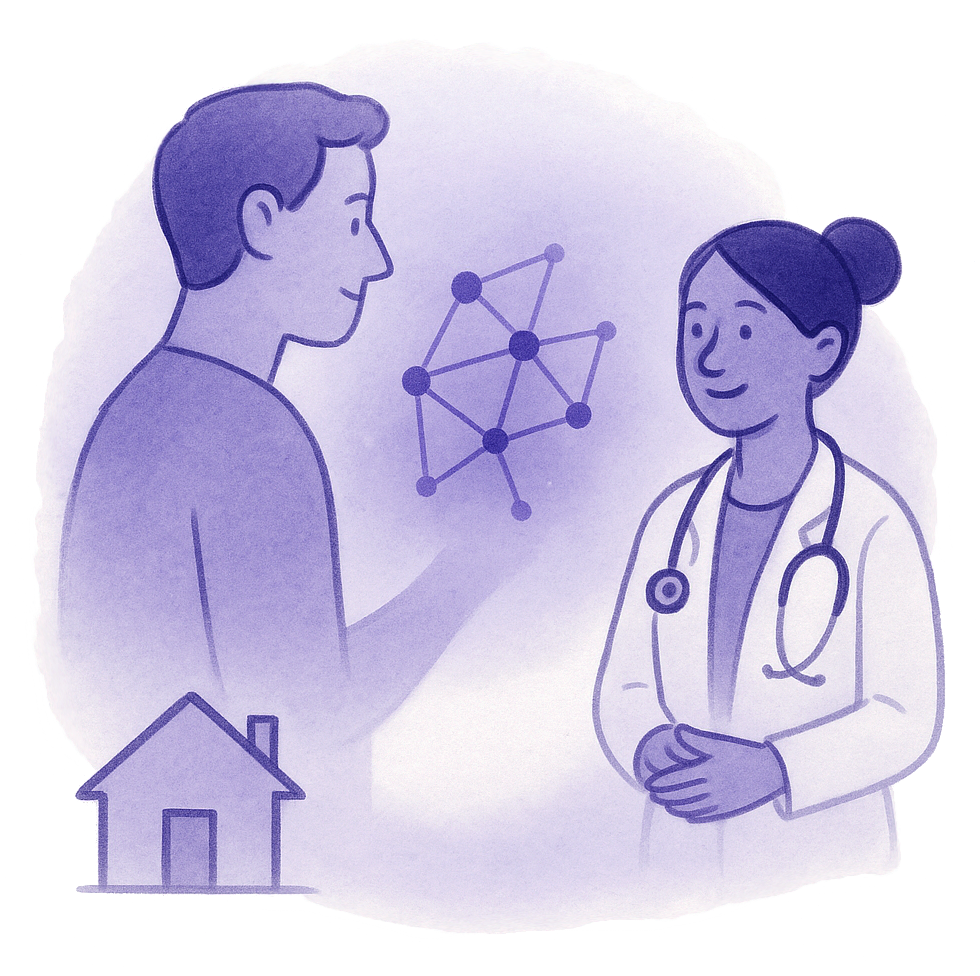
Illustration of proactive care continuity at home
Core Components

Knowledge. Intelligence. Interaction.

Three interdependent capabilities make up one Ibis Operating System. Scio is embedded in HealthGraph, and the Ibis interfaces connect the knowledge system to the people who use it and act on it.

1. Knowledge — HealthGraph™

HealthGraph is the continuously evolving knowledge system. It includes each member’s Digital Twin for Health™ (DT4H™) and connects health conditions, care plans, behaviors, circumstances, Care Circles, actions, and outcomes across concepts and time.

  • Maintains a persistent, evolving understanding of each member through their DT4H
  • Connects related concepts and relationships within and across members
  • Preserves context as health, circumstances, and care change
  • Organizes knowledge around whether the care plan is being followed and whether it is working

The Digital Twin is the member-level representation within HealthGraph—not a separate peer system.

2. Intelligence — Scio

Scio is the inference engine embedded within HealthGraph. It continuously turns information into knowledge, expanding HealthGraph through recursive feedback across concepts and time.

  • Interprets new information in the context of existing knowledge
  • Develops inferences across related concepts
  • Uses new knowledge to reconsider earlier observations and relationships
  • Reveals meaningful changes and new possibilities for support and action

Knowledge and inference are inseparable: Scio operates within HealthGraph, not as a separate processing stage outside it.

3. Interaction — IbisHub™ & IbisNexus™

The Ibis interfaces connect members and their Care Circles to HealthGraph’s evolving knowledge, making continuous engagement, coordination, and action possible.

  • IbisHub™: helps members follow their care plans, report changes, and engage in daily self-management
  • IbisNexus™: helps Continuity Specialists, nurses, clinicians, and other Care Circle participants understand needs and coordinate action
  • Supports communication, escalation, and follow-through
  • Brings human observations and actions back into the knowledge system

Human action expands the possibilities for machine inference, just as machine inference expands the possibilities for human action.

Two questions that organize the knowledge

HealthGraph develops the knowledge needed to answer two persistent questions about each member’s care plan:

Is the care plan being followed?

Understand the member’s actions, routines, support, and barriers—not simply whether a task was recorded.

Is the care plan working?

Understand changes in health, symptoms, function, and outcomes in the context of the plan and the person.

These questions inform each other. Scio’s inferences across concepts and time deepen both answers; Ibis and the Care Circle use that understanding to explore and take appropriate action.

Functional Architecture
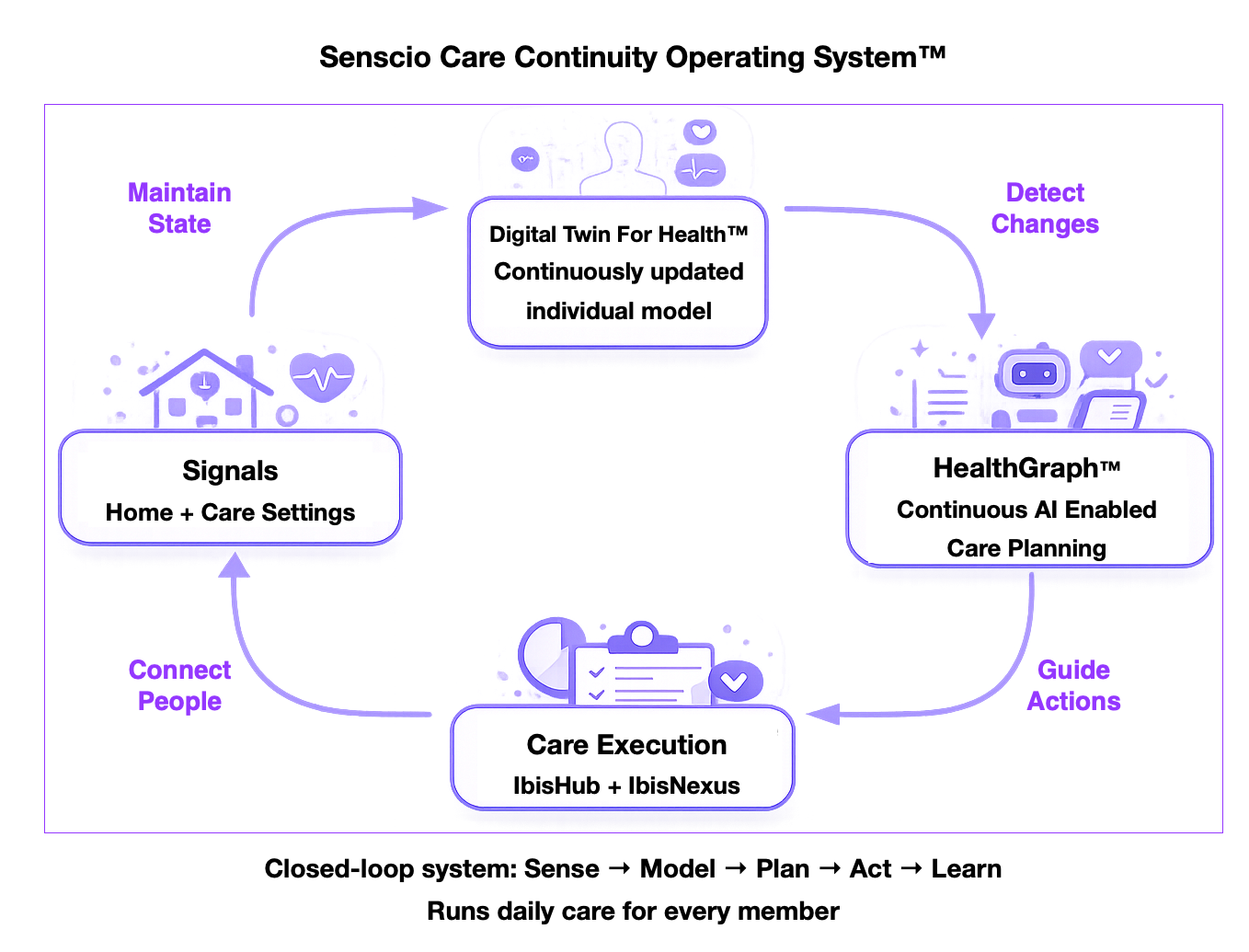
Diagram of Functional Architecture

How the Operating System works

Signals from home, clinical systems, payer systems, and the broader care ecosystem contribute to HealthGraph. Within it, Scio continually infers relationships across concepts and time; new knowledge can change the interpretation of both current and earlier information.

Knowledge creation and action reinforce one another through ongoing feedback:

  • Develop Knowledge: Scio draws inferences within HealthGraph, revisiting relationships as new information arrives.
  • Recognize Meaningful Change: evolving knowledge helps identify when the plan may not be followed or may not be working.
  • Expand Possibilities for Action: Ibis helps the member and Care Circle consider who can act, when, and how.
  • Learn from Action: human responses and their consequences create information that can support further inference and new paths forward.

These are interconnected activities, not a one-way sequence. Machine inference can open new options for human action; human action can open new possibilities for machine inference. The member remains the organizing unit as the Care Circle changes over time.

Signals Layer

Built to understand real members continuously

Ibis is not limited to one source of data or one moment in care. It is designed to absorb signals from the real healthcare ecosystem and continuously update each member’s Digital Twin as health changes.

Clinical Systems

  • EHRs: notes, diagnoses, medications, and care plans

Payer & Risk Systems

  • Eligibility
  • Claims
  • Risk adjustment
  • Prior authorization

Member & Home Inputs

  • Vitals and devices
  • Care plan adherence
  • Symptoms and behaviors
  • Home health notes

Community & Social Inputs

  • Referrals
  • Social care
  • Community services

These inputs contribute to HealthGraph, where Scio relates them to existing knowledge. Feedback across concepts and time helps reveal what the information means for the two care-plan questions and for possible action.

Why it matters

Why this architecture changes the scale and economics of care

  • Every member has a continuously updated Digital Twin for Health rather than a series of disconnected snapshots.
  • Every Care Circle can be engaged from the same evolving understanding of the member.
  • Every meaningful change can be translated into the right action by the right person at the right time.
  • Human actions can create new possibilities for Scio’s inference, just as machine inference can open new possibilities for human action.
  • Every new deployment strengthens HealthGraph and the continuity network.

Healthcare already has the providers. Ibis supplies the missing infrastructure that enables them to keep care continuous across home, organizations, and time.

Common questions

A clearer way to understand the architecture

What is a Digital Twin for Health (DT4H)?

A Digital Twin for Health is a continuously updated digital representation of a member’s evolving health state. It combines clinical history, current conditions, medications, behaviors, home observations, and care context into a persistent understanding of the member.

Why is a Digital Twin for Health important?

Continuous care depends on continuously understanding the member. The DT4H provides that persistent understanding, allowing Ibis to recognize meaningful change, determine who should do what, when, why and how, and help the Care Circle take timely action before small problems become crises.

What is HealthGraph?

HealthGraph is the evolving knowledge system connecting Digital Twins for Health, Care Circles, and related concepts. Its embedded inference engine, Scio, continuously creates knowledge through feedback across concepts and time. This knowledge supports two persistent questions: Is the care plan being followed? Is the care plan working?

What are IbisHub and IbisNexus?

IbisHub is the member-facing interface for daily engagement and self-management. IbisNexus is the Care Circle-facing interface for understanding needs, coordinating support, and following through. Together, they connect human action to HealthGraph’s evolving knowledge.

What is the Ibis Operating System?

The Ibis Operating System integrates HealthGraph’s knowledge, Scio’s embedded inference, and the IbisHub and IbisNexus interfaces. Together they help members and their Care Circles recognize needs, coordinate action, and learn from what follows.
Related insights

Want the deeper argument behind the architecture?

05

From State to Action

How continuous state, planning, and action form a closed loop for daily care continuity.

Ready to see how Healthcare Continuity Infrastructure works?

See how HealthGraph knowledge, embedded Scio inference, and the IbisHub and IbisNexus interfaces work together as one Operating System for continuous care.

See the Clinical Model Talk to Our Team