Helen’s Week
A multi-condition, whole-person case study showing how Ibis™ maintains persistent understanding, detects meaningful change, engages the right people, and helps keep care continuous before a crisis develops.
Helen’s week illustrates how a Digital Twin for Health™ (DT4H), HealthGraph™, and the Ibis Operating System work together as Healthcare Continuity Infrastructure while Helen’s Care Circle steps in and out as needed.
Member overview
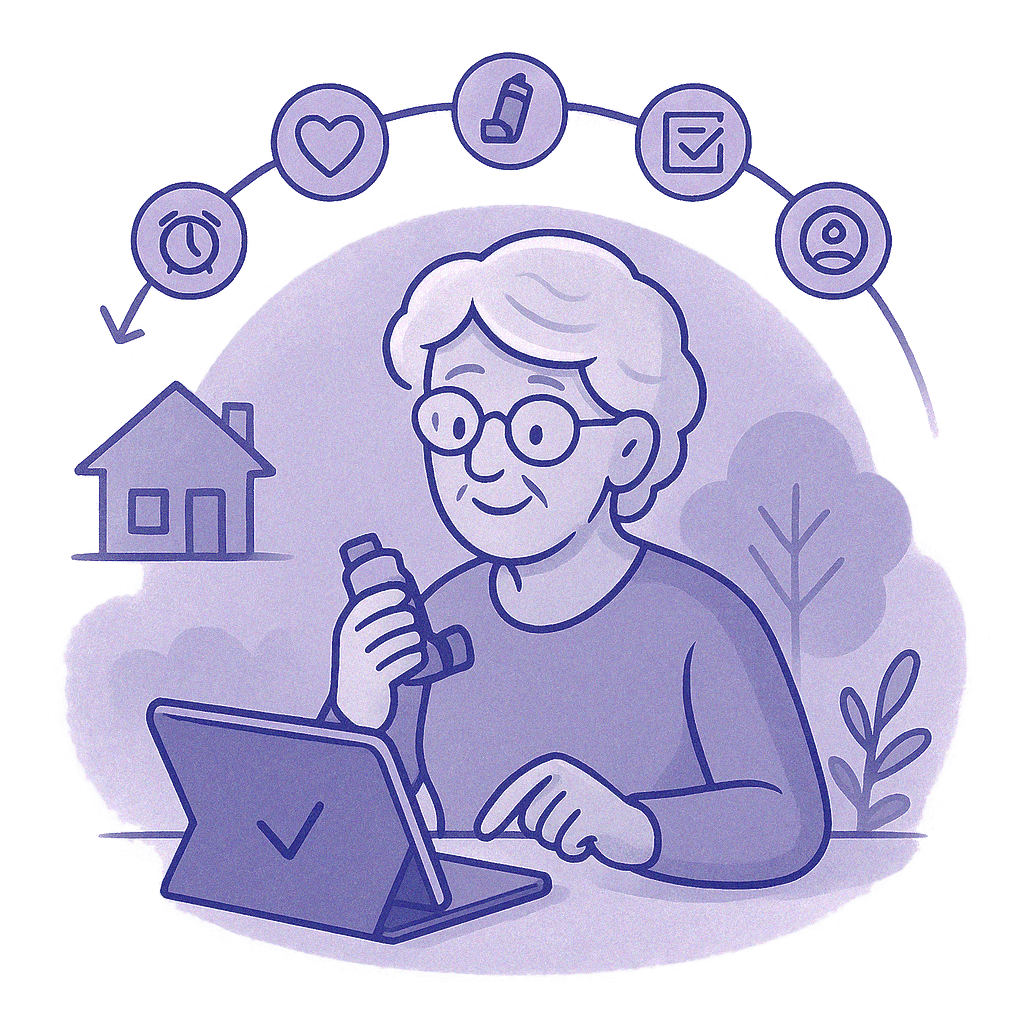
Helen, 76, lives alone and manages CHF, COPD, diabetes, hypertension, and mild depression. She recently experienced financial stress and has minimal nearby support. Her health changes continuously, but most of those changes happen at home between encounters.
Helen’s DT4H mirrors her evolving health state over time. As new observations arrive, Ibis maintains persistent understanding, recognizes meaningful change, determines who should do what, when, why and how, and follows the resulting actions through to completion.
⭐ Day 1 – Subtle physiological drift
Small but meaningful shifts begin: slight overnight weight gain, a small drop in SpO₂, increased resting heart rate, a missed inhaler dose, and disrupted sleep. Individually they may look minor. Together they begin to change Helen’s overall state.
- DT4H: Updates Helen’s evolving state across cardiopulmonary, behavioral, and adherence domains.
- Ibis: Recognizes that the combined pattern may be more important than any single reading.
- Action: Maintains a closer continuity watch as new information arrives.
⭐ Day 2 – Meaningful change emerges
The next morning, Helen logs rising weight, borderline oxygen levels, elevated glucose, and reduced engagement. The pattern now suggests that her state is moving away from baseline.
- DT4H: Reflects the combined change in fluid balance, pulmonary reserve, metabolic stress, and engagement.
- HealthGraph: Provides broader context from connected knowledge across similar conditions and patterns.
- Ibis: Determines that action is needed now rather than waiting for the next scheduled encounter.
- Action: Guided self-management is reinforced and clinical review is requested.
⭐ Day 3 – Whole-person context matters
Helen reports anxiety related to financial concerns. Poor sleep and stress are now compounding her clinical risk.
- DT4H: Incorporates the change in behavioral and social context into Helen’s current state.
- Ibis: Interprets the new information in context rather than treating it as a separate problem.
- Care Circle: The appropriate support is engaged for practical guidance, reassurance, and clinical follow-through.
⭐ Day 4 – The right provider is engaged
Helen’s pattern continues to worsen. Ibis determines that clinical judgment is needed and engages the appropriate provider in Helen’s Care Circle.
- Clinical review: The treating provider evaluates Helen’s evolving state and determines the appropriate treatment response.
- Ibis: Keeps the issue active, supports follow-through, and incorporates the resulting clinical decisions into Helen’s ongoing state.
- Continuity: The loop remains open until the necessary action is completed and Helen’s response is understood.
⭐ Day 5 – Stabilization
Helen’s vitals begin to normalize. Engagement returns. Anxiety decreases. Her state moves back toward baseline.
- DT4H: Reflects the recovery and updated treatment context.
- Ibis: Steps down the level of intervention as Helen stabilizes.
- HealthGraph: Retains the new observations and outcomes as part of the connected population knowledge.
Outcome
Helen avoids hospitalization. The important point is not that one alert prevented one admission. It is that Healthcare Continuity Infrastructure maintained persistent understanding of Helen while her health was changing at home, recognized when the change became meaningful, engaged the appropriate members of her Care Circle, and followed the resulting actions until the loop was closed.
Continuous care is achieved when the right action is taken by the right person at the right time in an effective way.