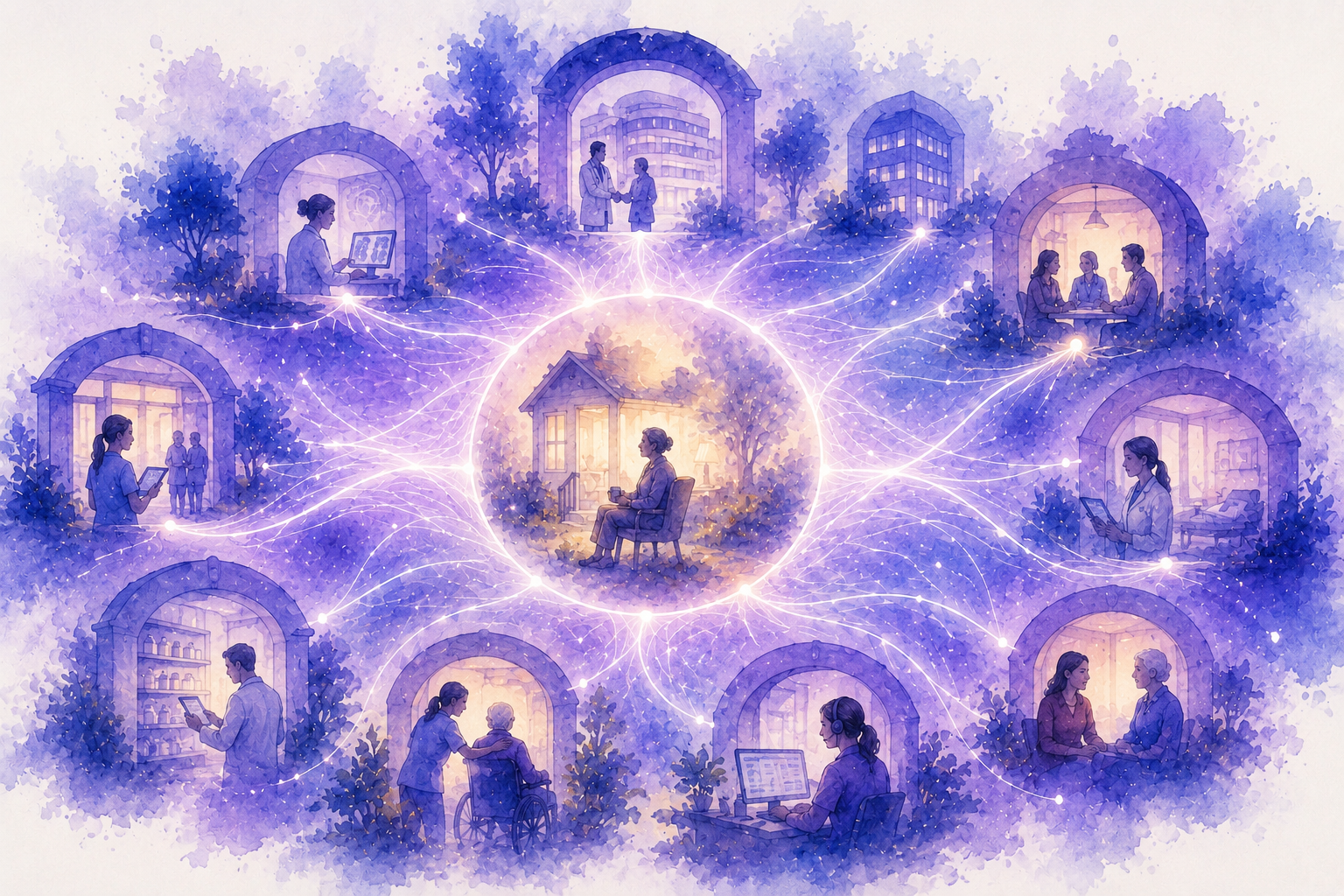
Healthcare services scale by being distributed.
No single organization can do everything a person may need across time. Hospitals, primary care practices, specialists, home health agencies, pharmacies, behavioral health providers, community organizations, health plans, caregivers, and families all play different roles. Each has different capabilities, workflows, economics, and responsibilities.
This distribution is necessary. It allows expertise to develop. It allows services to reach more people. It allows complex needs to be met by different organizations with different strengths.
But distribution also creates the central problem of continuous care.
The more care is spread across organizations, the harder it becomes to maintain one current understanding of the member. The member may have many providers, many records, many instructions, many portals, many handoffs, and many partial views. Yet no one institution continuously follows the member across all of them.
This is one reason continuous care has been so difficult to create.
It is not because healthcare lacks effort. It is not because people do not care. It is not because hospitals, physicians, home health agencies, plans, or caregivers are unimportant.
We do not have continuous care because distributed care has largely lacked shared continuity infrastructure.
That distinction matters.
Distribution is not the enemy. Unsynchronized distribution is the problem.
There is a useful analogy in the evolution of commerce.
At first, commerce was organized around individual stores. Each store had its own inventory, its own customer relationship, its own operating habits, and its own local knowledge. The customer could get what they needed, but they had to assemble the experience themselves.
Then came the town center. Stores were still separate, but they were located near one another. Proximity made the experience easier. A person could visit multiple stores in one trip. The town center created convenience, but each store still operated independently.
Then came the mall. The mall added a stronger organizing layer: shared parking, signage, security, hours, leasing, foot traffic, and a more coherent customer journey. The stores remained separate businesses, but the mall created a partial operating environment around them.
Then came Amazon.
Amazon did not merely collocate sellers. It created infrastructure that allowed distributed sellers to operate through one coherent customer experience. Search, identity, recommendations, inventory visibility, payment, fulfillment, reviews, returns, logistics, and customer service became part of one connected operating environment.
The mall synchronized place. Amazon synchronized operations.
Healthcare has built many versions of stores, town centers, and malls.
Independent providers are like individual stores. Referral relationships are like a town center. Health systems, clinically integrated networks, accountable care organizations, preferred provider networks, and post-acute partnerships are closer to malls. They bring organizations into some shared structure. They may improve access, contracting, referral flow, branding, and accountability.
These structures matter. They are necessary steps in organizing care at scale.
But a mall is not Amazon.
A network is not continuous care.
The fact that many services sit under one brand, one contract, one referral pattern, or one geographic footprint does not mean they are operating from a shared, current understanding of the member. A network can connect organizations without synchronizing the daily work of care. It can arrange relationships without maintaining state. It can create access without creating continuity.
This is the gap healthcare still has to close.
Continuous care requires more than a directory of services or a preferred network. It requires Healthcare Continuity Infrastructure: the technology and operational foundation that maintains persistent understanding of the member, detects meaningful change, determines who should do what, when, why and how, and helps the Care Circle close the loop.
The member is the organizing unit.
The Care Circle is the member’s actual provider network: the people and organizations through which the member receives care. Different participants step in and step out as needs change, but the member remains at the center.
That is the paradigm shift. Healthcare infrastructure has largely been organized around institutions. Continuous care has to be organized around the member because care occurs wherever it is most accessible, including the home.
Without continuity infrastructure, distributed care remains fragmented even when the organizations are formally connected.
A hospital may discharge a member with a good plan. A primary care clinician may intend to follow up. A specialist may adjust a medication. A home health nurse may notice a barrier. A plan may identify risk. A caregiver may observe a change. Each signal matters, but each signal is often held inside a different workflow.
The member experiences this as fragmentation. They repeat their story. They reconcile conflicting instructions. They wait for callbacks. They miss small changes until they become urgent. They are asked to navigate a system that is distributed but not synchronized around them.
The organizations experience it too. Providers work with incomplete context. Plans see utilization after the fact. Hospitals are judged by what happens after the member leaves. Home health sees the home but is constrained by the episode. Primary care is accountable between visits but cannot observe daily change.
Everyone is connected to the same member, but not always to the same living picture of that member.
That is the difference between a provider network and a continuity network.
A provider network connects participants. Healthcare Continuity Infrastructure keeps those participants connected to the member’s evolving state.
A provider network establishes relationships. Healthcare Continuity Infrastructure maintains persistent understanding.
A provider network can make referrals possible. Healthcare Continuity Infrastructure helps make continuity possible.
This is especially important for clinically complex people. Their needs do not fit neatly into one institution, one specialty, one episode, or one program. Their risk changes over time. Their stability depends on medication use, symptoms, function, behavior, social context, caregiver support, clinical judgment, and daily follow-through.
For these members, continuity cannot be created by asking every organization to do its part in isolation. The parts must work together around the member.
That does not mean every service has to be owned by one company. In fact, healthcare is too broad, local, specialized, and relationship-based for that to be the answer. Continuous care will not emerge because one organization replaces all others.
It will emerge when distributed organizations can work through shared continuity infrastructure.
This is the role of Ibis™.
Senscio is not trying to become every healthcare service. Ibis provides the Healthcare Continuity Infrastructure that helps distributed care operate with better memory, timing, context, and follow-through around the member.
A Digital Twin for Health™ (DT4H) maintains persistent understanding of each member’s evolving health state. HealthGraph™ connects those Digital Twins with the broader knowledge and relationships that give them context. The Ibis Operating System detects meaningful change, determines who should do what, when, why and how, and helps the Care Circle close the loop. Ibis Hub™ keeps the member connected to the system in daily life, while Ibis Nexus™ gives providers the context they need to act.
Together, these elements create Healthcare Continuity Infrastructure around the member.
The point is not to eliminate the network. The point is to make the network work continuously.
Hospitals still matter. Primary care still matters. Specialists still matter. Home health still matters. Plans still matter. Caregivers still matter. The member’s own participation matters most of all.
But each participant becomes more effective when the infrastructure around them maintains persistent understanding of the member, detects meaningful change, determines who should act, and follows action through to completion.
That is what turns distributed care into continuous care.
Healthcare has spent decades building networks. The next step is not simply to build bigger networks. It is to add the infrastructure that allows those networks to operate continuously around the member.
A mall made shopping more convenient by bringing stores together.
Amazon changed commerce by making distributed sellers operate through one coherent system.
Healthcare now faces a similar shift.
Networks can bring services closer together. Healthcare Continuity Infrastructure can keep distributed care synchronized around the member over time.