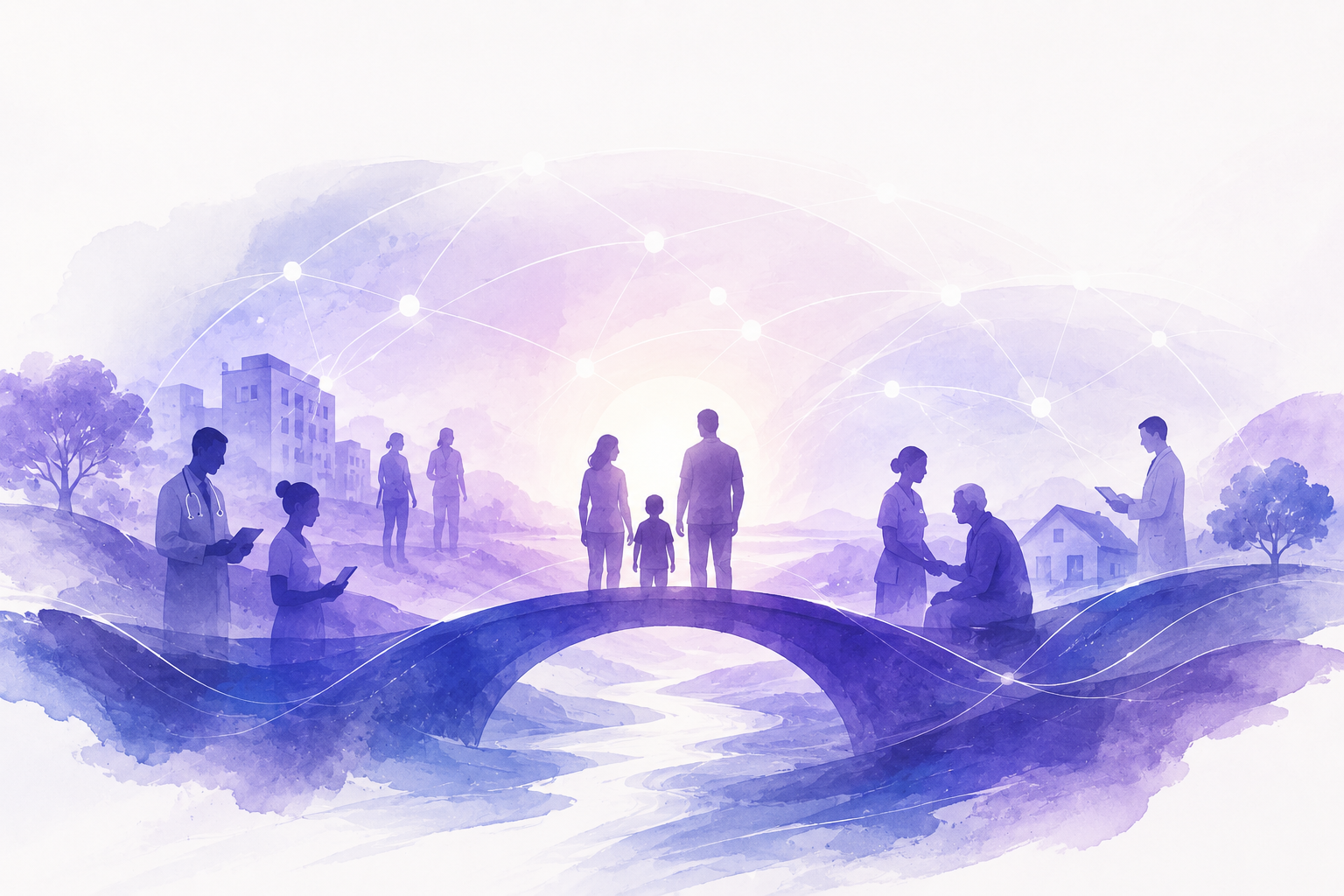
A healthcare operating system is not just software.
It only becomes real when three things come together: the technology that maintains continuity, the network through which care is delivered, and the participation of the people inside it.
Without the technology, care remains fragmented.
Without the network, the system has nowhere to act.
Without participation from members, caregivers, and providers, the operating system loses the living inputs that make continuity possible.
A successful operating system needs all three.
The first part is the technology.
This is the part people usually mean when they hear the term operating system. It is the stateful and coordinating infrastructure that maintains a current understanding of the person, detects meaningful change, guides what matters next, and keeps continuity from fragmenting across settings, tools, and time.
Technology is what allows the system to remain alive between encounters. It preserves state. It detects drift. It supports action before deterioration becomes expensive.
But technology alone is not a care system.
The second part is the network.
Care is delivered through a real ecosystem of people and organizations: primary care practices, specialists, home health teams, hospitals, discharge programs, caregivers, pharmacies, and others. They are the ones who perform the operations of care.
An operating system matters only if it can support that ecosystem and help it function more coherently around the person.
If the network is absent, weak, or disconnected from the operating system, then the system has intelligence without reach. It may know something important, but it cannot reliably turn that understanding into timely action through the people and roles that matter.
The operating system needs a network to work through.
But even technology plus network is still not enough.
The third part is participation.
Members have to participate. Caregivers have to participate. Providers have to participate. The operating system depends on living involvement from the people whose actions, observations, choices, and responses keep the pathway real.
Participation does not mean perfect adherence or constant activity. It means the system is being inhabited. Signals are being generated. Context is being updated. Care is being received, interpreted, and acted on.
A member responds to a prompt. A caregiver notices a change. A provider acts on a better-timed insight. A team member follows through on a recommendation. These are not side effects. They are part of what keeps the operating system meaningful.
Without participation, the graph goes stale.
The technology may still exist. The network may still exist. But the living continuity that the operating system depends on begins to weaken.
This is why healthcare operating systems cannot be understood as software products alone.
They are socio-technical systems.
The technology creates the continuity layer. The network gives that continuity operational reach. Participation keeps the continuity layer alive and useful.
If any one of these three is missing, the whole system weakens.
Technology without network becomes isolated intelligence.
Network without technology becomes fragmented effort.
Technology and network without participation become stale coordination.
But when all three are present, something more powerful becomes possible.
The system can maintain a living picture of the person. The network can act from better timing and better context. Members, caregivers, and providers can participate in a pathway that stays coherent even as needs change.
That is when continuous care stops being an aspiration and becomes an operating model.
This is also why success cannot be measured only by software performance.
A healthcare operating system succeeds when the technology remains current, the network remains connected, and the people inside it remain engaged enough to keep continuity real.
That is the deeper architecture.
Not software alone.
Technology, network, and participation working together.